
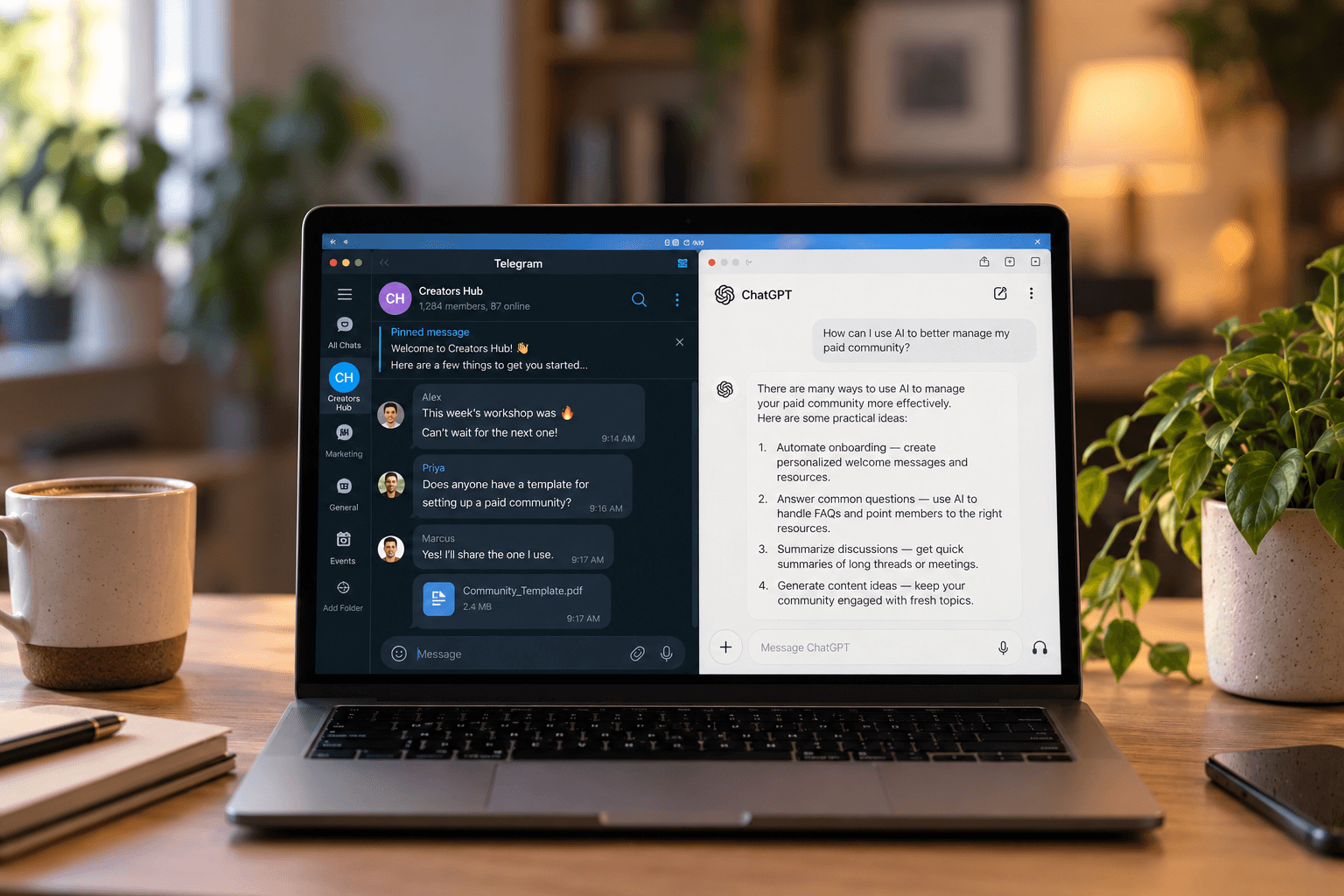
The payments are handled. Members are in the group. The platform is running. Then Monday comes and you open a blank message box and wonder what to post today.
That is the actual work of running a paid group. Not the setup. Not the access control. The ongoing, weekly job of producing content good enough that people keep paying for it. Members do not renew because the group exists. They renew because last month had value they could point to.
According to Forrester, 90% of online communities will integrate AI in some form by 2026. McKinsey's 2025 survey found 78% of organizations were already using AI in at least one business function, with 71% using generative AI regularly. Where AI fits in a paid community, and what it should not touch, is the practical question.
Where AI actually fits
AI does not know your niche. It cannot critique a member's squat form, give exam feedback from real marking experience, or advise on a member's business from context it has never seen.
What AI can do is remove the blank page. The part of community management that burns creators out is not the expertise. It is the packaging: writing the intro to a post you already know the answer to, drafting a welcome message for the tenth new member this month, thinking of a discussion question for a quiet Thursday. These tasks take time and cognitive load that could go toward the actual content.
AI handles the packaging. You supply the substance.
Six productivity gains that add up fastest
Writing weekly group posts
Most community creators post the same types of content every week: a market update, a workout breakdown, a study tip, a business case study. The structure is usually the same. The insight changes.
Write a prompt once that describes your post format: "Write a [type of post] for my paid [niche] community. Structure: [your structure]. Tone: [your tone]. Length: [target]. I will fill in the actual insight."
A fitness coach might use: "Write a workout breakdown post for a paid WhatsApp fitness group. Structure: what we are training this week, why this works, how to modify for beginners. Warm but direct tone. 150 words. Leave [EXERCISE] and [RATIONALE] as placeholders I will fill in."
That prompt produces a usable shell in ten seconds. You add the real content. The post that used to take 30 minutes takes 10.
Drafting the new member welcome
The first message a new member receives sets the tone for everything that follows. Most creators write it once when they launch and never revisit it. The result is a welcome message that no longer matches how the group has evolved.
Use AI to draft one that covers what the group is, what gets posted and when, how to ask questions, and one quick win they can get from the group today.
Try: "Write a welcome message for a new member of my paid [niche] community on [Telegram/WhatsApp]. The group posts [what you post] every [frequency]. The tone is [describe it]. Under 150 words, warm and specific."
Review the output, rewrite it in your voice, and save it. When a new member joins, send it within the first hour.
Re-engaging a quiet group
Every paid group has quiet periods: a lull between course modules, a week when members are heads-down applying what they learned, a slow stretch before a new cohort joins.
Silence reads as low value, even when it is not. It is one of the main reasons members cancel, and how to reduce churn in your paid community covers the specific patterns that lead to non-renewal.
When the group goes quiet, use AI as a prompt generator: "Give me five discussion questions for a paid [niche] community. Questions should prompt members to share their own experience, not just answer yes or no."
Pick the question that fits the week. A good discussion thread from one prompt generates more perceived value than five passive posts from the creator alone.
Handling repeated member questions
Every community has questions that come up constantly. In a fitness group: what should I eat around my workouts? In a business coaching group: how do I price my services? Most creators answer these individually, every time.
Use AI to draft thorough responses to your five most common questions. Actual thoughtful answers that cover the question fully, not canned responses that feel robotic. Review each one, add anything specific to your approach, save them. When the question comes up, paste the relevant response and personalize the first line.
Research on AI chatbots in community settings shows response times cut by up to 60%. Most creators do not need a bot. They need a bank of well-drafted responses they can send in 30 seconds instead of spending five minutes writing the same answer again.
Building a 30-day content calendar
Content consistency is the difference between a community that retains members and one that sees cancellations spike at month-end. Getting your first paying members is one challenge. Keeping them on renewal month after month requires a content rhythm they can count on.
Ask AI to generate a 30-day content calendar. Give it context: your niche, the types of posts you make, the frequency you can sustain, your audience's primary goal. The output will not be perfect. Some ideas will not fit your approach. Cut those, keep the rest, fill in the specific content yourself. A rough calendar covering 80% of your posting needs is more useful than no calendar at all.
Repurposing one post into several
A detailed post you wrote in 30 minutes can generate a week's worth of content. Paste it into ChatGPT or Claude and ask it to break the piece into three to five shorter posts, each covering one distinct point.
A business coach who writes a detailed breakdown of a client mistake can pull five posts from it: the mistake itself, why it happens, how to avoid it, a related question members should ask themselves, and a quick win they can apply today. That is a full week of content from one piece of work.
What AI cannot do
The thing that justifies the subscription is always something AI cannot provide.
A fitness community runs on form corrections: looking at a member's video and saying what needs to change. AI can write about squat mechanics. Watching your member squat is a different job entirely.
In an exam prep group, it is the specific feedback: "here is why this answer is wrong" from someone who has seen hundreds of students attempt this question. AI can generate practice questions. Marking them the way an experienced tutor does is beyond it.
In a business coaching community, the value is the critique: reviewing a member's pricing strategy, reading their sales page, telling them what is missing. AI can write a generic pricing framework. Applying it to a specific business with full context is a different thing.
The posts members actually renew for are the ones containing the creator's specific expertise. AI handles the surrounding work.
Memberlet and AI together
Memberlet handles the operational side of the group: payments come in, members get access, subscriptions renew automatically, and members who stop paying are removed without the creator doing anything.
The work of keeping members engaged is separate, and that is where AI earns its place. Two distinct workloads run a paid community: the administration and the content. Memberlet takes the first off the table. AI shrinks the second.
A creator running a 100-member group can operate it in a few focused hours a week, without the admin side touching them.
Start your paid community on Memberlet and let the platform handle payments, access, and renewals while you focus on the content that keeps members paying.


